

Disclosure: This post includes affiliate links. As an Amazon Associate, we earn from qualifying purchases (at no extra cost to you), allowing us to continue sharing helpful, valuable, and supportive resources.
Boys Have Feelings Too: The Emotional World Many Parents Never See
Every boy has an emotional world. Some boys talk about it more openly than others, but every boy experiences emotions that shape how he thinks, behaves, connects, and grows.
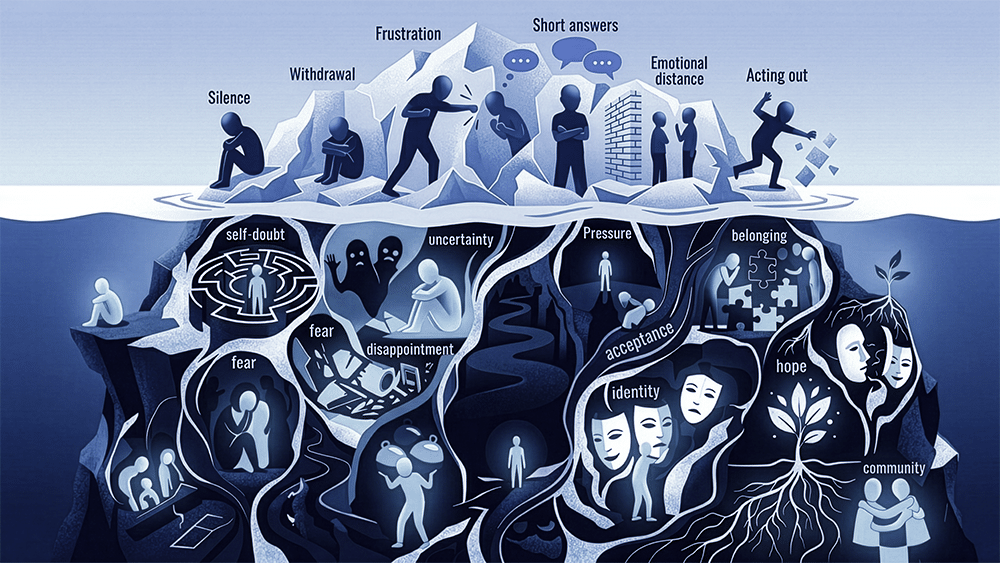
The challenge for parents is that those emotions aren’t always easy to see. While behavior happens on the surface, emotions often happen beneath it. That’s why understanding your son’s emotional world requires more than listening to what he says. It often requires paying attention to what he struggles to express.
In This Article
The Behavior You Can See and What It Might Be Telling You
Parents naturally notice behavior first. We see frustration after a difficult day, hear short answers, and notice when our son becomes quieter, more distant, or more defensive than usual. Those changes get our attention because they’re visible. They’re the part of the story happening right in front of us.
What can be harder to recognize is that behavior is often carrying a message. A son who suddenly seems unmotivated may be struggling with discouragement. A son who becomes defensive may be hiding embarrassment or self-doubt. A son who pulls away may be working through questions he’s not yet ready to discuss.
While the behavior is real, it isn’t always the whole story. Behavior can tell us that something is happening. The next challenge is understanding why many boys struggle to explain what that something is.
Why Boys Don’t Always Express What They’re Feeling
Once parents begin looking beyond behavior, another question naturally follows: If something deeper is going on, why doesn’t he simply tell me?
The answer is often more complicated than it appears. Many boys aren’t hiding their emotions on purpose. In many cases, they’re still trying to understand what they’re feeling themselves. Before a boy can explain something to someone else, he first has to make sense of it internally.
Not every boy responds the same way. Some become quiet and withdrawn. Others become frustrated, defensive, or quick to anger. Some create emotional distance, while others act as though nothing is wrong at all. These responses may look very different on the surface, but they can point to the same reality: a boy struggling to process emotions he doesn’t fully understand or know how to express.
Growing up, boys are often taught to fix problems, stay strong, and push forward. Those skills are valuable, yet they don’t equip a boy to identify, talk about, and work through his feelings. Because of this gap, unspoken emotions often surface in his behavior instead of being put into words.
What He May Be Struggling to Express
When emotions are difficult to express, they don’t simply disappear. They continue influencing how a boy sees himself and the world around him.
That’s why looking beyond behavior matters. Beneath a son’s actions, reactions, and moods, there is often an emotional experience he hasn’t yet learned how to communicate.
He may be questioning whether he’s good enough, trying to figure out where he belongs, carrying disappointment from a setback he hasn’t shared, or comparing himself to others more than anyone realizes.
He may feel pressure to meet expectations he’s not sure he can reach. He may worry about failing, letting someone down, or not measuring up in ways he doesn’t openly discuss.
Many boys carry these thoughts quietly, not because they want to hide them, but because they haven’t yet developed the confidence, language, or emotional awareness needed to express them fully.
Recognizing that possibility changes the way we respond. Instead of immediately reacting to the behavior, we become curious about the experience behind it.
Why These Feelings Matter More Than You Think
Parents naturally see the events in their son’s life. They see school, sports, friendships, responsibilities, achievements, and setbacks.
What can be harder to see is how he’s interpreting those experiences. Two boys can experience the same event and walk away with very different conclusions about themselves. One may see a setback as temporary, while another quietly begins questioning whether he’s good enough.
The same is true of success. One boy may feel encouraged by it, while another may feel pressure to maintain it. What shapes a boy isn’t always the event itself, but the meaning he attaches to it.
Those private conclusions often influence his confidence, decisions, relationships, and sense of identity far more than parents realize. Understanding your son’s emotional world isn’t just about knowing what happened. It’s about understanding what those experiences mean to him.
What Changes When He Feels Understood
When boys feel understood, they don’t suddenly become different people. What often changes is their willingness to let someone into their world.
Conversations become easier. Defensiveness softens. Trust grows. A son becomes more willing to share not because he’s forced to, but because he feels safe enough to do so.
Understanding doesn’t eliminate every challenge, nor does it guarantee that a boy will always talk openly. What it often changes is how he experiences those challenges. Instead of feeling like he has to figure everything out alone, he knows someone is willing to walk alongside him. That sense of support can make difficult moments feel more manageable and successes feel more meaningful.
What Understanding Really Looks Like
If understanding your son’s emotional world sounds overwhelming, the good news is that it doesn’t require having all the answers. It doesn’t mean agreeing with everything he does, nor does it require becoming an expert in psychology.
More often, understanding looks like slowing down long enough to listen. It looks like paying attention to patterns, asking thoughtful questions, and staying curious when behavior doesn’t immediately make sense.
The goal isn’t to read your son’s mind.
The goal is to know him well enough that he feels safe sharing what’s on his mind.
Three Simple Steps to Understanding Your Son’s Emotional World: Reflect • Act • Connect
When you’re trying to better understand your son’s emotional world, remember three simple steps:
Reflect
Pause long enough to consider what he may be feeling beneath the behavior. The more curious you become, the more likely you are to see beyond the surface.
Act
Respond with intention rather than urgency. Once you understand more about what he’s experiencing, your actions are far more likely to address what actually matters.
Connect
Focus on strengthening the relationship while addressing the challenge. Connection doesn’t remove boundaries or accountability. It makes both more effective.
Understanding comes first. Everything else grows from there.
A Deeper Way to Understand Your Son
If you’d like a deeper, guided way to explore what understanding your son truly means — especially in the everyday moments that shape who he’s becoming — the resources below offer a simple, common‑sense path forward. No scientific jargon or pedantic, surface‑level advice here — just clear, logical guidance grounded in everyday wisdom that simply works.
The Heart of Being a Son: What Boys Need From Adults to Grow with Character and Confidence #ad
Understanding your son is a journey — one that becomes clearer when you have a gentle, grounded resource beside you. The Heart of Being a Son was created for that purpose. It helps you see him more fully, connect with him more deeply, and support him with confidence as he grows.

Workbook for The Heart of Being a Son: An Interactive Guide For Adults Who Raise Boys From Childhood To Adulthood #ad
For those who want to turn understanding into everyday connection, The Workbook for The Heart of Being a Son provides thoughtful questions and simple exercises that help you bring these foundations into daily life. It turns understanding into action, and action into connection.
Let This Stay With You: Understanding Your Son’s Emotional World Is an Ongoing Journey
Some of the most important things your son feels may never be announced out loud. They may appear in his questions, his frustrations, his silence, his distance, his uncertainty, or the moments when he simply seems different from usual.
You won’t always know exactly what he’s experiencing. No parent does. But when you stay curious, remain available, and create space for honest conversation, you make it easier for him to share more of his inner world with you.
Your son doesn’t need someone who knows everything he’s feeling. He needs someone willing to stay curious about the person he’s becoming.
Because for many boys, being understood isn’t just comforting.
It’s transformative!
And as always, don’t forget to S.U.N (Stay Uplifted Naturally)!
Disclosure:
Some of the links in this article are Amazon Affiliate links, meaning we may earn a small commission if you make a purchase through these links, at no extra cost to you. We only recommend books and products that we believe can make a positive difference in your everyday life, and we truly appreciate your support in making our work possible. Thanks so much for supporting our work! And as always, Stay Uplifted Naturally!
Disclaimer:
Welcome to S.U.N! Just a quick note: we’re here to share helpful information, but we’re not a replacement for medical, legal, or other professional advice. Our content is meant to support you, not take the place of medical or mental health treatment. If you think you might have a condition, please see a professional. And as always, Stay Uplifted Naturally!